Showing posts with label new mexico. Show all posts

Saturday, October 1, 2011

Trinity

At 5:29 a.m., on July 16, 1945, much of New Mexico was awaken by a huge shock wave, accompanied by breaking windows. A brilliant yellow light was seen as far north as Albuquerque and Los Alamos, as far west as Silver City, and as far south as El Paso, Texas! Army officials told the public that a munitions storage area had accidentally exploded at the Alamagordo Bombing Range.

It was not until after the bombing of Hiroshima, Japan, on August 6 of that same year, that President Truman announced that the United States had created an "atomic bomb," which had first been tested in New Mexico . . . on July 16, 1945. Three days after Hiroshima, on August 9, a third bomb was dropped on Nagasaki. On August 14 the Japanese surrendered.

The secret development of the atomic bomb was code-named the Manhattan Project, and the site where the first a-bomb was detonated is known as Trinity and is located on the White Sands Missile Range. Most of the time it is locked down, but twice a year the public is invited to visit. Today was one of those days, and Dan and I made the two-and-a-half-hour trip down to see the Trinity site.


There isn't actually much there to see. Originally there was a 100-foot steel tower, with a shelter on top, where the bomb was placed and eventually detonated. The tower was vaporized in the blast. All that is left to see is one of the footings from that tower.


A Ground Zero monument has been constructed at precisely the location beneath where the atom bomb perched on the tower. A replica of the Fatman bomb casing (the bomb that was dropped on Nagasaki) is on display, and a number of historic photographs hang on the perimeter fence. It isn't so much what you can see; it's more about the sense of awe inspired by standing in the place where such a monumental historic event occurred.


Scientists estimate that the temperature of the fireball created from the explosion was approximately 14,710 degrees Fahrenheit! It was so hot that it melted the desert sand beneath the tower and turned it into a sheet of radio active green glass. This green material was dubbed Trinitite. In 1952 the Atomic Energy Commission contracted to have most of the Trinitite scraped up and buried. However, there are still very tiny pebbles of it all over the ground at Ground Zero. It is against federal law to remove any of the Trinitite from the ground. It is still somewhat radio active.


The site is still somewhat radio active, however they reassure you that you would get more radiation doing some rather routine things . . . a chest x-ray would give you about 12 times as much radiation as one hour at Trinity; a coast-to-coast commercial flight would give you about 4 times as much radiation. I have to admit I felt a little leery standing there, but, as you can see, the resident lizards really do have four legs and only one tail!


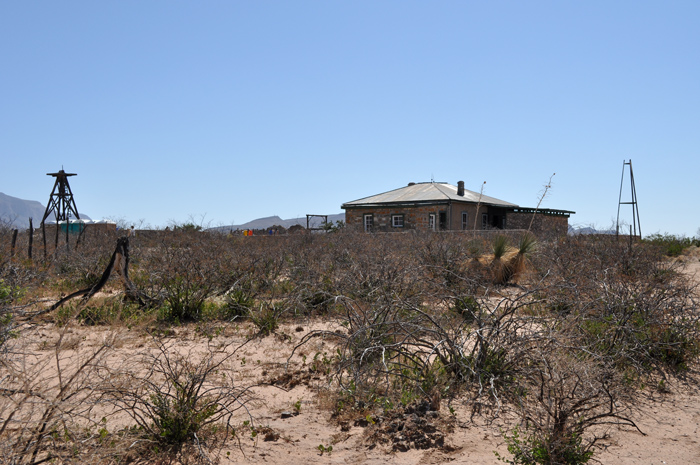
Buses are available to take visitors the two miles to the old McDonald Ranch house. The main bedroom in this old adobe-covered-in-plaster house was used as the assembly room for the Manhattan Project. I enjoyed walking through it. It has tons of character and must have been a lovely home when it was lived in by the McDonald family. Many of the Manhattan Project staff actually witnessed the explosion from this house -- only TWO MILES AWAY!


After leaving Trinity, we made a stop at The Owl Cafe in San Antonio, NM, about 34 miles away and on our route home. The Owl is one of those places that you MUSTN'T miss if you are anywhere in the area. It is most famous for its green chili cheese burgers, and the burgers are made with beef they grind, themselves, at the cafe. The reason we felt compelled to stop there was the historic connection the cafe has with Trinity. Trinity personnel frequented The Owl, and some say the green chili cheeseburgers were first made to satisfy their appetites. Another story we've heard, but I can't confirm, is that The Owl had the only telephone within miles, and that the report of the success of the bomb's detonation was reported from that phone.


The building is one of those places that is built like a maze. You enter into one room, and then wind your way through room after connecting room to find a place to sit. It's dark inside, and the walls are covered in paper money, scrawled with messages and names of those customers who tacked them there. Once a year the money is taken down and given to charity. I read that as of 2009 more than $19,700 had been donated. (This section of wall, below, was mostly or entirely foreign currency, but there are many walls plastered with good old U.S. of A. dollar bills.)

Thursday, May 1, 2008

Spring Winds and Forest Fires

It's been a spring marked by continuing high winds in this part of New Mexico. High winds in country as dry as this are frightening; any lightning bolt, cigarette, or spark can lead to run-away forest fires, spread rapidly by the wind.

One such forest fire has been burning in the Manzano Mountains, not far from Albuquerque, for over two weeks now. On Tuesday it was reported to be 90% contained, but yesterday's roaring winds rekindled it, and sent it out of control again. As of this evening, it had consumed 11,000 acres. Albuquerque's normally blue skies are heavy with drifting smoke.

Officials are unable to say how many homes and businesses have been lost, because the heavy smoke prohibits visibility. Today's winds were between 40 to 60 m.p.h. and kept air tankers and helicopter crews on the ground. Approximately 500 people, from Torreon and Tajique and everything in-between those two towns have been evacuated, and others have been warned to be prepared to evacuate.

This fire is burning along the scenic route where Sherry and I did our photo shoot back in September.

My heart goes out to these home- and business-owners.

Sunday, March 16, 2008

Drifting Along With the Tumbling Tumbleweeds

Although Albuquerque is known for its year-round nice weather, it isn't Heaven! And a day like today is indisputable proof of that! Springtime is here, and with it come occasional sandstorms, like we are experiencing today.

Leaving church, we headed west to Corrales where we had plans to meet friends for lunch. It was an ugly trip, with huge gusts of wind; reddish brown sand, snaking across the road; and dense air, the same color as the sand, obscuring even the nearby scenery. Dan tried his best to dodge the tumbleweeds that danced across the road from south to north . I found myself humming an old song made famous by The Sons of the Pioneers (I'm showing my age, aren't I?). The beginning of the song went something like this:
I'm a roaming cowboy riding all day long,
Tumbleweeds around me sing their lonely song.
Nights underneath the prairie moon,
I ride along and sing this tune.

See them tumbling down
Pledging their love to the ground
Lonely but free I'll be found
Drifting along with the tumbling tumbleweeds.
The Sons of the Pioneers made it sound almost romantic, but trust me, there was nothing romantic about today's storm that blew sand into Dan's eyes and beneath his contacts; turned my chewing gum into a gritty mass; and attacked my sinuses, leaving me with a headache.

I'm looking forward to tomorrow, hoping for a return to the "Land of Enchantment."

[Kelsey and Gloria - don't let this post deter either of you from your planned visits to our fair city. I'll put in a special request for good weather while you're here. ]

Thursday, January 24, 2008

Red or Green?

(Note: This post was written for my friend, Gloria. I promised her an explanation of Mexican vs. New Mexican cuisine. But I thought others might find it interesting, as well.)

Most states have a state flower, a state bird, even a state song. But did you know that New Mexico has an official state question? It’s true. The state question is, “Red or green?” This is the question inevitably asked of you when ordering a meal at a New Mexican restaurant, and refers to the red or green chiles that will top your entree.

Most of the Mexican restaurants in the Albuquerque area are, more accurately, “New Mexican” restaurants. The cuisine differs from the Tex-Mex restaurants I was used to before moving here. New Mexican food comes from a blend of Indian, Spanish, Mexican and Anglo influences. Probably the most obvious difference, though not the only one, is the prominent role of the chile in New Mexican dishes. (Notice, this is “chile” as opposed to “chili.” “Chili,” in New Mexico, refers to the ground beef, chili powder, tomato sauce and – sometimes – pinto bean concoction. “Chile” on the other hand is the fresh vegetable – I’m told it’s actually a fruit – grown in-state.)

New Mexico is famous for its home-grown chiles. Some are picked while still green. They are then roasted until the skin blisters, peeled, and chopped into a green chile sauce. Others are left to ripen, until they are red. The green ones must be used fresh, or be frozen fresh from the field, unlike the red ones that can be dried and ground into a powder and shipped anywhere. Therefore the green chile stays fairly close to home, for the most part, making it a regional specialty. (Note – the color of the chile does not indicate its “hotness.” There are both mild and hot green chiles, and mild and hot red chiles.)

Some differences you’ll notice when eating New Mexican food include the addition of vegetables, such as chunks of potatoes or corn in your tacos or enchiladas (an Indian influence); blue corn tortillas, in addition to the white or yellow varieties; the absence of jalapeƱo peppers and cumin (a spice used in Tex-Mex); and the method of preparation, especially for enchiladas.

Let’s talk about enchiladas. I was most familiar with beef and/or cheese enchiladas, wrapped in white or yellow corn tortillas, smothered in a fairly mild, creamy red enchilada sauce, with shredded cheese on top, the whole concoction then baked in an oven for a half-hour. (I’m making myself hungry!)

But when I order enchiladas in a New Mexican restaurant, they can be quite different. Corn tortillas are still used – sometimes white corn or sometimes blue. The tortillas have a small amount of the filling placed upon them. If you order beef, there will probably not be any cheese added. Sometimes they are then rolled, but often they are left flat. No enchilada sauce is used. Instead, the warmed tortilla and its filling are served topped with either red or green chiles – your choice. The chiles are chopped and made into a sauce, similar to a salsa. The enchiladas are never cooked in the chile sauce. If you, like me, don’t “do” chiles, then you just get the tortilla with a little dry meat or cheese on it. (Can you tell I miss the enchilada sauce I’m used to?)

Available at many New Mexican restaurants, as well, are authentic Mexican dishes, such as posole (a hominy, pork, chile stew), menudo (a spicy soup made with tripe, hominy and chile), and chorizo (a pork sausage).

One nice thing is that, at most New Mexican restaurants, your meal includes freshly fried, hot sopapillas and honey, always a delicious end to dinner.

Thursday, January 17, 2008

Baby, It's Cold Outside!

For the most part, Albuquerque has mild winter temperatures, but right now we are in a cold spell that is reminding me of my years in Alaska. When I left for work this morning it was 13 degrees, and, according to the radio, the windchill brought it down to -2. I used to be okay with that kind of weather, but after 4-1/2 years here I guess I've become acclimated. It's even worse because we don't have the cold-weather clothes that we had in Alaska.

Some of you may be watching my "366 Photos for 2008" blog, and if so you've probably noticed that I've had to settle for indoor pictures the past couple days. But the weather man is predicting a gradual warming trend, so hopefully I'll be back out there snapping shots around the city pretty soon.

Wednesday, September 19, 2007

Salinas Pueblo Missions - September Photo Shoot

[Warning - this is pretty lengthy. If you don't want to read the entire post, please click here to see my photos, anyway. Maybe they'll tempt you to read about them :-) Click on first photo, then click "next" to see another. Be sure to go to page 2.]

On Tuesday Sherry and I initiated our "Monthly Photo Shoot Adventures." This month Sherry planned the day and provided transportation. She came by my office at noon, and we grabbed a quick bite to eat, then hit the road. The weather couldn't have been better - sunshine, blue skies, and only about 80 degrees.

Our route was:
I-40 east from Albuquerque to NM 337 (at Tijeras); south 54 miles to Mountainair
From Mountainair, Highway 60 west (about 40 miles) to I-25
North on I-25 to Albuquerque


We first stopped at the Tijeras Pueblo Archaeological Site. This was not impressive. Sherry and I, at the end of the day, agreed it had been 30 minutes of time that would have been better-spent elsewhere.

On our way south, on 337, we passed through a half-dozen small villages of, probably, 50 residents or less. We found lots of picture-taking opportunities, and pulled over to take advantage of them. Our first stop was an old abandoned "little house on the prairie," with a rusted-out shell of a car parked in front. It was just south of Tijeras and was such an interesting little place. I say "little", but as we went on around to the rear of the house, we saw what was hiding behind the overgrown trees and bushes. The house had obviously grown with the family, for there were three attached structures. The front and rear were stucco, but the center section was a log cabin. (There was some evidence that there had been stucco on these logs, too, at one time, but it had deteriorated and fallen off.) On the rear section hung Christmas decorations, and we wondered how many winters they had seen, since it was obvious that the house hadn't been lived in for many, many years. It was on private property, and was behind a wire fence, so we weren't able to see the inside, though our curiosity was killing us.

We also stopped at probably a half-dozen old cemeteries along the way. Some were interesting, but they were not as old as we had hoped, most of the people having died in the mid-20th century. We were on the lookout for snakes all the while we roamed these burial grounds. We didn't see any, but saw their holes everywhere, and at one place found a l-o-n-g snake skin, molted and left lying part-way in and part-way out of its hole. Sherry also spied a small tarantula, which I got a rather fuzzy picture of. It was high-tailing it down its hidey-hole, and wouldn't stop to pose for us.

In Manzano we were grateful to find a small grocery store (the only one we saw on the trip down), where we purchased a cold drink and a snack, and used their restroom facilities. It was a nice, clean little store, and the clerk was friendly. I bought some Carrizozo Cherry Cider there, and it was very good.

Finally we arrived at the first of the Salinas Pueblo Missions, known as Quarai. All of the Salinas Pueblo Missions were built in the early 1600s. They were abandoned in the 1670's, probably due to a severe drought in the area. The missions were built by the Catholic Church, near the pueblos where the Native American people already lived. Surrounding the missions are also some surviving ruins of these pueblo dwellings.

When we arrived at Quarai, the caretaker told us we had only 25 minutes until it closed. We had spent so much time in the grave yards that we would have to cut our time here short. What a shame! Because this was an astoundingly beautiful place. We walked up to the ruins, the walls of which rose at least 50 or 60 feet high. Visitors are free to roam anywhere they wish - in and out of the mission itself, into the labyrinth of small rooms built beside the church, where the Catholic priests lived and studied. It is a totally hands-on experience. We noticed a path that led to a copse of trees, where there are picnic tables. We were determined, after our brief 25 minutes were up, to bring Keith and Dan back and explore this place in more depth. And we'll bring a picnic lunch to eat under the trees.

From the Quarai ruins, we drove the 8 miles on to Mountainair. Keith and his partner (DBA: Eagle Custom Homes) have been building some homes in Mountainair, on a beautiful piece of wild country, called Deer Canyon Preserve. Keith was there, so we drove out to Deer Canyon to see him. We took a tour of one of his custom homes, which is nearly complete.

When we left Deer Canyon, in Mountainair, we headed to a second of the Salinas Pueblo Missions, known as Abo'. It is about 9 miles west of Mountainair. Although it was past the official closing time, we decided that closing time only applied to the visitor center, for the ruins are wide open, with no gate or barrier. When we first arrived, some people were there, sitting in their car, while their children ran and played around and through the ruins. They soon left, and, as the sun was setting, Sherry and I had the place to ourselves. The setting sun made it difficult to get pictures from the front of the mission, but we got some nice ones from the west side, where the last rays were lighting up the rear of the mission. This structure was not quite as complete as Quarai, but, none the less, amazing. There is a trail that leads to the pueblo itself, but because it was getting dark, we had to pass that up this time. There were numerous old adobe ruins within sight of the mission, though, all a part, I assume, of the pueblo dwellings. We must return to this one, as well, with Keith and Dan.

We had no time to drive to the third of the Salinas Pueblo Missions, Gran Quivira. From what we read, we believe Gran Quivira has a completely different type of construction from the other two missions. It is about 25 miles from Mountainair. What was amazing to both Sherry and I was that there were no crowds of people visiting these missions. At Quarai we saw one couple, and two other ladies, one of whom was in a wheel chair. At Abo', after the two children left, we were completely alone. Granted, it was a week day, but for the most part I think these jewels are off of the tourists' radar!

On our way home, we stopped at Los Lunas (on I-25) for dinner. Keith, who was also on his way back to Albuquerque, met up with us there. It was about 8:00 when we sat down to dinner, and every bone in Sherry's and my bodies ached. We had tromped around and through abandoned houses, old gas stations, cemeteries, patches of wild flowers and ruins; and climbed into and out of her SUV innumerable times that day. But it had been so well worth it. I'll be planning the October photo shoot adventure, and I have a tough act to follow!

Okay - be sure you view the pictures here!


Friday, September 14, 2007

Who Was Juan Tabo?

Almost every city has streets named after famous people in history. For example, in Portland, Oregon, where we lived for a long time, there is a street named Couch (pronounced kooch) Street. It was named after a 19th century sea captain who was an early resident and founder of Portland. And in Juneau, Alaska, where we also lived, Seward Street runs through the center of downtown. Seward Street is named after William Seward, Lincoln's Secretary of State who negotiated the purchase of Alaska from Russia -- for two cents an acre!

So, when we moved to Albuquerque, and I saw the name of a major north-south road, on the East side, called Juan Tabo, I was curious about this (apparently) Spanish gentleman. I figured he must have been very important in Albuquerque's history, especially considering all of the businesses also bearing his name.

I took Spanish in junior high and high school, so using the rules of pronunciation that I'd been taught, I figured this name was pronounced Juan Ta'bo, with the accent on "Ta." Nope, I was quickly corrected by my very nice neighbor, Lorraine. It is Juan Ta-Bo' - accent on "Bo." Ever since, I've been trying to figure out where this mysterious sort-of-Spanish-sounding name came from. And what I've learned is that it is an Albuquerque mystery.

As I suspected, people agree that the last name, Tabo, does not appear to be Spanish. But no one knows for sure who Juan was. Everyone, however, has a theory:
  • Some people say Juan was a Pueblo Indian shepherd who pastured his sheep in that East Mountain area (near where the road is today), and that Tabo was his nickname, not his real last name.
  • Some say he was a Spanish priest, but the name doesn't appear in early church records.
  • Some old-timers here say that Juan was a guy from Carnuel who walked along the edge of town with his cows, sheep and a bunch of dogs, and sold tortillas and tamales to the townspeople. They say this shepherd's route later became a well-traveled road, and was named after Juan. The tough part of this theory, though, is that Juan Tabo Blvd. is located many miles from where "town" would have been back "in the days." I don't think he'd have had many tamale customers.
  • Others claim that the name Tabo came from the Toboso Indians of Texas.
  • I read one person's theory that Juan Tabo was the Spanish Conquistador Francisco Vazquez de Coronado's pet cat! (Not a likely theory, but someday, if I ever have a cat or dog, I think I might name it Juan Tabo.)
  • Another person claims that Tabo is a Spanish word in the Philippines, meaning "cup made from coconut shell." Now that really clears things up, doesn't it?
And here's an interesting piece of trivia - there is also a road named Juan Tabo in Tucson, Arizona - this little shepherd-tamale-salesman-priest guy got around!

I'll keep asking questions, but I've learned that Albuquerquians just seem to pick their favorite Tabo story and claim it as truth - or make up a new story to add to the collection. I might mention here, though, that if you come to Albuquerque to visit, you'll probably want to go to Juan Tabo Blvd., and take the cutoff up to the Juan Tabo Picnic Area. It's really a beautiful drive, especially in the evening when the sun is setting, no matter who it is named after!

The cutoff road going up the mountain to Juan Tabo Picnic Area

[References:
http://www.dukecityfix.com/index.php?itemid=2607
http://www.city-data.com/forum/albuquerque/57337-who-juan-tabo-why-did-they.html]

Saturday, September 8, 2007

The Burning of Zozobra

Old Man Gloom a.k.a. Zozobra burning at Fiestas de Santa Fe, September 8, 2005. Photo by Jeff Weiss

Did you wake up yesterday morning with a renewed feeling of hope? Did it feel like some burden had been lifted from your shoulders? Well, the people of Santa Fe would tell you that your relief came from the burning of Zozobra, on Thursday evening.

Every fall over 40,000 people go to Fort Marcy Park in Santa Fe to watch Zozobra, a 50-foot tall effigy (also called Old Man Gloom) burn. Zozobra's burning kicks off the Fiestas de Santa Fe, a three-day festival that started in 1712 and originally celebrated the retaking of the city, in 1692, by Don Diego de Vargas after the Pueblo Revolt in 1680. Zozobra, though, was a late-comer to the festival. His burning has been a part of the Fiestas for only 83 years - since his first appearance in 1924.

Zozobra is a giant, animated marionette that waves its arms and growls and moans all day before he is set afire. He is grotesque looking, as Old Man Gloom should be, I suppose. According to the tradition, as the flames devour Zozobra, they also devour all of the gloom of the preceding year, leaving everyone with a fresh outlook on life.

I've never gone to Old Man Gloom's burning. I saw him one year, and heard his mournful growls, while he was hanging and awaiting his fate, but didn't stay in Santa Fe for the evening festivities. This year I thought maybe I'd go up for it (a challenging picture-taking opportunity). But it turned out that Zozobra was torched on the same night as the Evening of the Arts, which I didn't want to miss.

In New Mexico's 300+ years of recorded history, a culture rich in Native American, Spanish, Mexican and Catholic influences has evolved. Zozobra is a prime example of this cultural potpourri. As fascinating as it is, and despite the festivities and the lore surrounding Zozobra, I wouldn't want to leave the impression that the burning of a 50-foot marionette, made of wood, cloth and paint, has any real power to dissipate gloom or renew life.

Oh, but wait . Here's the good news. There is a way that leads to such a new beginning: "We were therefore buried with him through baptism into death in order that, just as Christ was raised from the dead through the glory of the Father, we too may live a new life." Romans 6:4

Monday, August 20, 2007

Chestnuts Chilis Roasting on an Open Fire

Everyone has a favorite time of year, I suppose, and mine, hands-down, is fall. I can't even explain why, or how, it stirs and invigorates me, every year, when the leaves begin to turn and the morning air turns nippy. Maybe it's because I've been on some sort of academic calendar - whether as a student, a teacher, a school volunteer, a teacher-certifier, or a university staff member - for 47 years; so, to me, fall means, a new beginning. Or maybe it's because fall is a precursor to the holiday season, which I love. Or, maybe it's that the colors, the smells and the tastes of the season are simply delicious.

In Albuquerque, I've come to recognize a new sign of the season, for it's in the fall when they harvest and roast the chilis. You can go to a supermarket or a farmers' market, buy your favorite variety of fresh chilis, and take them out to the parking lot, where someone will roast them for you.


Yesterday, for the first time this season, even before I stepped out of the car, I smelled the pungent aroma of roasting chilis. That's when I realized that I must actually be a New Mexican at last, because the smell of the chilis signaled inside me the coming of fall.

Wednesday, August 15, 2007

These Are a Few of My Favorite Things

Dan occasionally says, speaking of New Mexico, "I really like it here, but I'm not sure you like it as much as I do." I wish I could put his mind at ease, because I do like New Mexico, even more than I thought I would before we moved.

Some things I like about New Mexico:

  • Beautiful and varied scenery
  • Hot air balloons
  • Four distinct seasons
  • Awesome sunsets
  • The combination of Hispanic and Native American cultures, arts and foods
  • New Mexico's rich history
  • Shorter travel distances to family
  • Albuquerque's good shopping
  • Abundance of cultural opportunities (concerts and other performances)
  • The new friends we've made

If we were to leave New Mexico, I would miss these things, and more. But that doesn't mean I don't miss some things about Oregon and Alaska. I think that is what is confusing Dan when he asks if I really like New Mexico.

Some things I miss about Oregon:

  • Pumpkin patches in the fall
  • Christmas tree farms, where we cut our own real trees
  • U-pick fields and orchards, where we could pick sweet corn, strawberries, peaches, apples, Marion berries, and on and on
  • Houses that are made out of something besides stucco
  • The Oregon coast - my favorite place for renewal
  • Camp Yamhill
  • Thick, lush green lawns
  • The smell of bark dust
  • Powell's Bookstore and Fred Meyer
  • Great Chinese restaurants
  • Teaching ESL classes at George Fox University
  • The old friends I left behind
Some things I miss about Alaska:
  • Fresh-out-of-the-water salmon, halibut and king crab
  • Cool summer temperatures
  • Long, long summer days
  • Deep snowfalls
  • The Northern Lights
  • The view we had from our condo (see the picture above)
  • Day trips on the ferries
  • The Permanent Fund Dividend
  • Certain smells that mean "home" to me: skunk cabbage, low tide, creosote on the docks, spruce trees
  • Up-close-and-personal encounters with black bears, eagles and whales
  • The old friends I left behind